Gordon Gray
American PrometheusGordon Gray was the chairman of the Atomic Energy Commission’s three-member security review board that considered J. Robert Oppenheimer’s clearance in 1954. A former secretary of the Army and president of the University of North Carolina, Gray entered the case without understanding its stakes or Lewis Strauss’s hostility to Oppenheimer. He ultimately voted to deny the physicist’s clearance, despite accepting that the proceeding was an inquiry rather than a trial and despite the dissent of fellow board member Ward Evans. Gray’s role illustrates how an administrative hearing could be shaped by unequal access to evidence and by an expansive definition of security risk.
Background and Appointment
Gray was a conservative Democrat, an old friend of Strauss, and a member of a wealthy Southern family whose fortune came from the R. J. Reynolds Tobacco Company. He had served as secretary of the Army in the Truman administration and was then president of the University of North Carolina. He had voted for Dwight D. Eisenhower in 1952. These political and personal details helped make him an attractive choice to Strauss, who wanted board members likely to distrust Oppenheimer once his left-wing associations appeared in the security file.
Strauss appointed Gray to chair the board, alongside Thomas A. Morgan, chairman of the Sperry Corporation, and Ward Evans, a professor emeritus of chemistry at Loyola and Northwestern universities. Gray did not know what he was entering. He seemed to expect the assignment to last a couple of weeks and assumed Oppenheimer would be cleared. When Gray suggested David Lilienthal as a possible board member, Strauss instead chose Morgan. The final board, in the biographer’s account, consisted of men who knew little about Oppenheimer’s history as a fellow traveler but could be shocked by the contents of his file.
The Hearing and Its Unequal Procedures
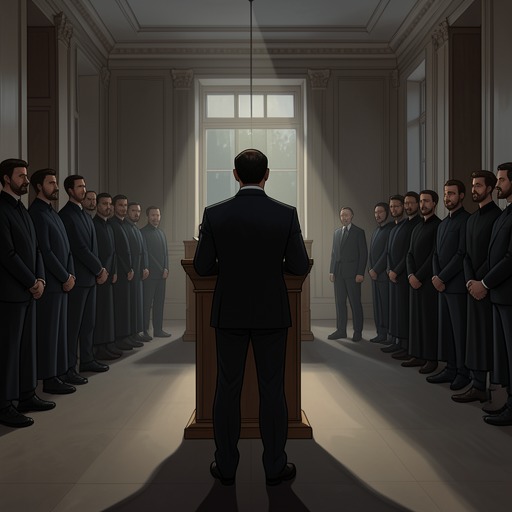
The hearing opened on April 12, 1954, in Room 2022 of Building T-3, a wartime temporary structure near the Washington Monument. Gray sat with Morgan and Evans behind a mahogany table bearing black binders of classified FBI documents. Oppenheimer’s lawyers were alarmed: the board had studied those files in advance, while the defense had neither copies nor a chance to challenge documents that were not introduced openly. Oppenheimer, meanwhile, spent the month on a leather couch when he was not in the witness chair, where he would be questioned for about twenty-seven hours.
Gray began by reading aloud the Atomic Energy Commission’s charges and Oppenheimer’s written reply. He repeatedly maintained that the proceedings were an “inquiry,” not a trial, even though the charges and the board’s authority made the experience trial-like. The allegations ranged from Oppenheimer’s past associations and contributions to Communist causes to his failure to report promptly a 1943 conversation about a proposal to pass scientific information to the Soviet Consulate. They also accused him of hindering the hydrogen-bomb program. Oppenheimer acknowledged friendships and political associations but denied that they were sinister; he described his earlier outlook as that of a fellow traveler.
The imbalance was not limited to what the binders contained. Before the hearing, Gray allowed the government’s attorney, Roger Robb, to meet privately with the board to review FBI files, while Oppenheimer’s lawyer, Lloyd Garrison, was denied the same opportunity. Gray accepted Robb’s recommendation that Garrison not receive a comparable briefing, did not share Ernest Lawrence’s damaging written testimony with the defense, and did nothing to expedite Garrison’s security clearance. The board also allowed the prosecution to keep its witness list from the defense. These choices gave the government’s case a procedural advantage before Oppenheimer took the stand.
When the New York Times published the story on the hearing’s second day, Gray blamed Oppenheimer and his lawyers for the disclosure. Oppenheimer interrupted to acknowledge that his counsel had given the documents to reporter James Reston. Gray’s anger was misdirected: Strauss, not Garrison, had authorized publication, in part because he feared Senator Joseph McCarthy might reveal the case first. Gray did not know that Strauss had arranged the release, and the episode showed how the public narrative surrounding the hearing could be managed without the chairman understanding who had set it in motion.
Judgment and Dissent
Gray’s own private assessment initially portrayed the proceeding as fair within its constraints. He wrote that it had been “as fair as circumstances permit,” while acknowledging that Oppenheimer and his counsel could not see some FBI reports and other classified material. He was also mildly uncomfortable with Robb’s cross-examination and his piecemeal, unexpected use of documents. Yet Gray concluded that the procedure had caused no damage to Oppenheimer’s interests when considered as a whole. His qualification treated the defense’s exclusion from key material as a circumstance to be accommodated rather than an imbalance requiring correction.
Gray’s view of the evidence centered on Oppenheimer’s habit of putting his own judgment ahead of official government judgments. He cited the Chevalier affair, Oppenheimer’s defense of Bernard Peters, the hydrogen-bomb debate, and other policy positions. Gray and Morgan agreed that Oppenheimer had shown poor judgment. Gray was therefore surprised when, after a ten-day recess, Evans returned with a draft dissent supporting Oppenheimer. Evans said that a review of the record had persuaded him there was nothing new in the charges; Gray, by contrast, had believed Evans was inclined to deny restoration from the outset.
On May 23, the board ruled two to one that Oppenheimer was a loyal citizen but a security risk. Gray and Morgan recommended that his clearance not be restored. Their reasoning did not accuse him of breaking a law or even violating security regulations. Instead, they judged that his associations and conduct suggested susceptibility to influence, insufficient candor, and a troubling attitude toward the hydrogen-bomb program. They treated loyalty to friends when it conflicted with what they considered obligations to the government and security system as relevant evidence against him. In effect, personal loyalty and dissenting policy judgment became grounds for a security penalty.
Evans’s dissent sharply challenged that conclusion. Most of the derogatory information, he noted, had already been in the government’s hands when Oppenheimer received clearance in 1947. He warned that denying clearance would be “a black mark on the escutcheon of our country.” His dissent exposed the difficulty of treating old, previously reviewed associations as newly disqualifying, but it did not persuade Gray to change his vote. The Atomic Energy Commission later accepted the recommendation against Oppenheimer, with Henry DeWolf Smyth the sole commissioner voting to reject the board’s decision.
Responsibility and Historical Significance
Gray was not the architect of the campaign against Oppenheimer; that role belonged chiefly to Strauss. But chairing the board gave Gray the power to insist on a fairer process. The account of the hearing stresses that he could have restrained Robb’s tactics and enforced the commission’s security procedures. Instead, he accepted one-sided access to the FBI files and left the defense without comparable opportunities. His insistence that the hearing was not a trial did not remove its punitive force or repair its procedural imbalance.
The case also placed Gray within a wider conflict over whether scientists could challenge military policy and remain government advisers. During testimony, Vannevar Bush argued that a board should not decide whether a man could serve his country merely because he had expressed strong opinions. Gray responded that Oppenheimer’s file contained other derogatory items beyond the expression of opinion. Yet the final judgment made Oppenheimer’s opposition to accelerated hydrogen-bomb development a significant concern, alongside associations and disputed candor. The boundary between security review and punishment for dissent consequently remained central to the verdict.
The hearing damaged the public standing of its decision-makers as well as Oppenheimer’s government role. Publication of the transcript exposed the proceeding’s inquisitorial character, while support for Oppenheimer spread among scientists and academics. Gray’s significance lies in the contrast between his apparent initial expectation that Oppenheimer would be cleared and his eventual participation in denying the clearance, and between his acknowledgment of procedural limitations and his acceptance of the outcome they helped produce. His chairmanship made him responsible not simply for a vote, but for the fairness of the process through which that vote acquired authority.